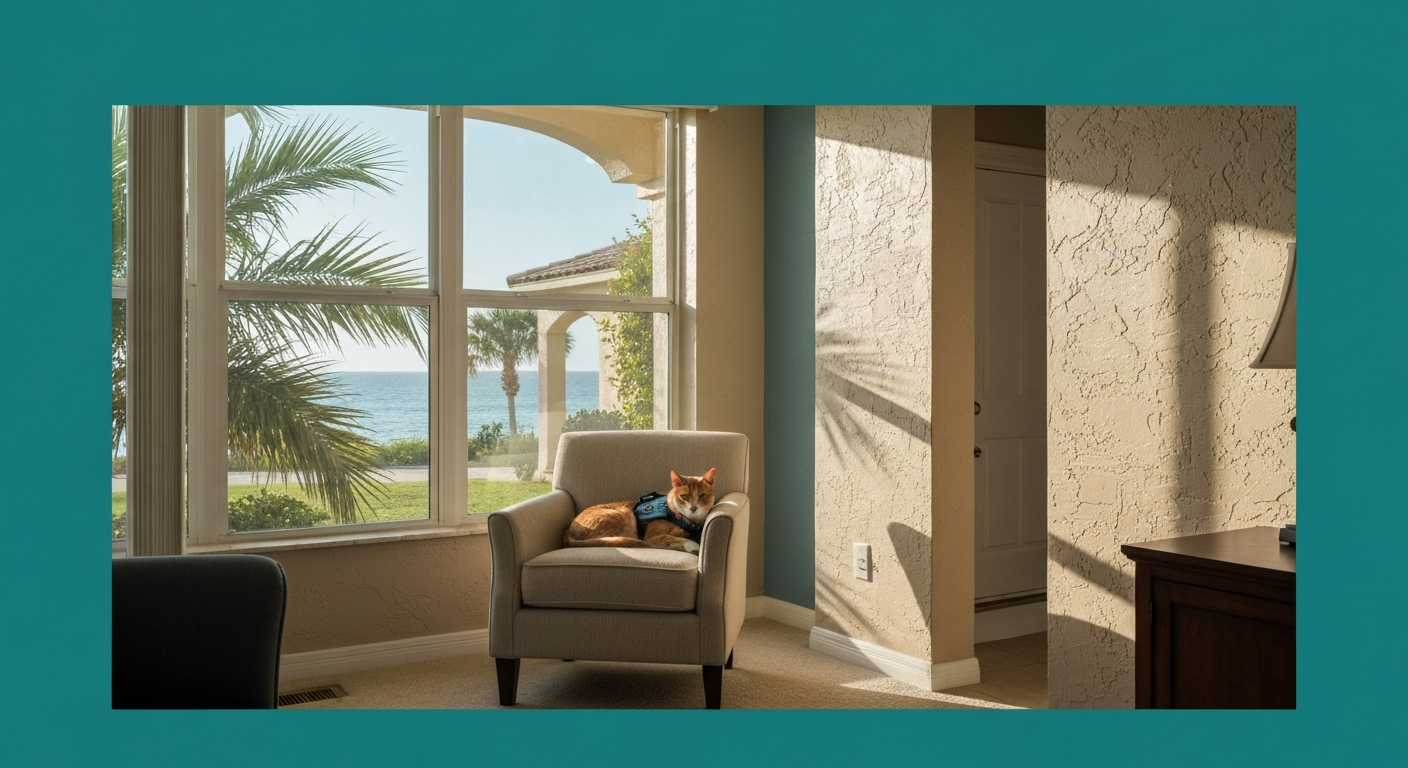
ESA Letter Renewal in Florida: Why HUD Recommends Updating Every 12 Months
Informational content only. Nothing in this article constitutes medical, mental-health, or legal advice. Consult a Florida-licensed mental health professional to determine whether an emotional support animal is therapeutically appropriate for you, and consult a Florida-licensed attorney for any housing dispute or enforcement matter.
You secured your emotional support animal letter, moved into your Florida apartment without a pet deposit, and life with your ESA has been genuinely stabilizing. Then a renewal notice arrives — or, more commonly, it doesn't, and your landlord suddenly questions whether your documentation is still current. Understanding the renewal cycle before that moment arrives is the difference between seamless continuity of your FHA-protected accommodation and an avoidable gap in coverage.
This guide walks Florida residents through exactly why ESA letters carry a recommended 12-month validity window, what HUD's authoritative guidance says about documentation currency, and how to move through the renewal process with a Florida-licensed clinician — the only type of provider whose letter meets the requirements of Florida Statute § 760.27.
Why ESA Letters Don't Last Forever: The HUD Standard Explained
HUD's landmark guidance document, FHEO-2020-01 — formally titled Assessing a Person's Request to Have an Animal as a Reasonable Accommodation Under the Fair Housing Act — is the controlling federal authority on what housing providers may and may not ask when a tenant presents an ESA letter. Within that notice, HUD explicitly states that housing providers may request "reliable documentation" that is current and may verify whether the identified disability-related need is ongoing.
While HUD does not mandate a specific expiration date printed on every letter, it acknowledges that a housing provider can reasonably request updated documentation when a reasonable accommodation was previously granted and circumstances may have changed. Industry standard among reputable licensed mental health professionals (LMHPs) has accordingly converged on a 12-month renewal cycle — a cadence that reflects both the nature of ongoing clinical assessment and the practical expectations of Florida housing providers operating under the FHA.
Put simply: a letter dated two or three years ago may be technically valid in isolation, but it may not satisfy a diligent housing provider's reasonable request for current clinical documentation, and it will not reflect any updated therapeutic rationale your clinician has developed over the intervening months of treatment.
What Florida Law Adds to the Federal Framework
Florida's own fair-housing statute, FL Statute § 760.27, mirrors and in some respects supplements the FHA's protections. Critically, Florida law specifies that a valid ESA letter must be issued by a mental health professional who is licensed in the State of Florida — or who has an established prior in-person therapeutic relationship with the client. This means that out-of-state, online-only telehealth providers cannot issue a legally compliant Florida ESA letter, regardless of how professional their website appears or how quickly they promise to deliver documentation.
This requirement has direct implications for renewal: if your original letter was issued by a Florida-licensed clinician who has since moved out of state or allowed their Florida license to lapse, your renewal must involve a currently Florida-licensed provider. Verify licensure status at any time through the Florida Department of Health's MQA Online Services portal.
For a deeper look at what separates a legally defensible letter from a document that could be challenged, see our guide to what makes a Florida ESA letter legally valid.
What You'll Need Before You Begin the Renewal Process
Treating renewal like any other professional appointment — arriving prepared — saves time and produces a more thorough clinical interaction. Gather the following before contacting your clinician or scheduling a renewal evaluation:
- Your existing ESA letter — the original document, including the clinician's name, Florida license number, license type, and date of issuance.
- Current housing documentation — your lease or a recent renewal notice identifying the property address, the landlord or property management company, and any "no-pets" clause language.
- A brief personal summary — a written or mental note on how your ESA has been contributing to your mental health since the last letter was issued. Clinicians benefit from hearing specific, observed changes in your symptoms or daily functioning.
- Any updated medical or psychiatric records — if you have seen a psychiatrist, physician, or therapist since your last letter, relevant notes that document your ongoing condition may support the renewal evaluation.
- Your ESA's current information — species, breed, name, and approximate age or weight, particularly if any of these details have changed since the original letter.
- A valid government-issued ID — confirming Florida residency, which aligns with the Florida-licensed clinician requirement under § 760.27.
Step-by-Step: How to Renew Your ESA Letter in Florida
-
Step 1 — Check Your Letter's Issue Date and Assess Urgency
Locate your existing ESA letter and note the date it was issued. If that date is approaching or has passed the 12-month mark, begin the renewal process immediately rather than waiting for a landlord inquiry. Florida housing providers are permitted to request updated documentation, and having a current letter on hand eliminates any window of potential dispute. If you are in the process of securing ESA housing protections under the FHA in Florida, a current letter is essential from day one of that conversation.
-
Step 2 — Confirm Your Clinician's Active Florida Licensure
Before scheduling anything, verify that your existing clinician — or any new provider you are considering — holds an active Florida license. Eligible license types include Licensed Clinical Social Worker (LCSW), Licensed Mental Health Counselor (LMHC), Licensed Marriage and Family Therapist (LMFT), psychologist, and psychiatrist. In some circumstances, a licensed primary-care physician practicing in Florida may also qualify. Search the Florida Department of Health's MQA portal and confirm the license status reads "Active" — not "Delinquent," "Inactive," or "Null and Void."
-
Step 3 — Schedule a Renewal Evaluation (Not Just a Document Request)
A legitimate renewal is a clinical evaluation — not a rubber-stamp transaction. A Florida-licensed LMHP will conduct a reassessment of your mental health condition, your ongoing disability-related need for an emotional support animal, and whether the specific animal you have continues to provide meaningful therapeutic benefit. This evaluation may occur via HIPAA-compliant telehealth if the clinician holds an active Florida license and the platform meets state telehealth standards, or in person at a licensed Florida practice. Plan for a session of meaningful length — typically 20 to 45 minutes.
-
Step 4 — Participate Honestly and Thoroughly in the Clinical Assessment
During your renewal evaluation, describe specifically how your ESA has affected your daily functioning — sleep quality, anxiety management, ability to leave the home, social engagement, or whatever dimensions are most relevant to your situation. A clinician will determine whether an ESA remains therapeutically appropriate; that determination is theirs to make, not yours to dictate. Many people with qualifying mental health conditions find an ESA genuinely supportive over many years, and an honest, detailed account of your experience gives the clinician the full picture they need to make a well-informed clinical judgment.
-
Step 5 — Review the Renewed Letter for Required Elements
Once issued, review the renewed letter carefully before submitting it to a housing provider. A legally compliant Florida ESA letter should include: the clinician's full name, Florida license type, Florida license number, and contact information; the date of issuance (reflecting the current evaluation, not the original letter date); a statement that you have been assessed and have a disability-related need for an emotional support animal; identification of the specific animal; and the clinician's original signature. It should not make any claim about airline travel rights — ESAs lost federal air-travel protections under the Air Carrier Access Act in 2021, and any letter claiming otherwise is outdated or misleading.
-
Step 6 — Submit the Renewed Letter to Your Housing Provider Proactively
Do not wait for your landlord to ask. Proactively provide your renewed letter to your housing provider or property manager with a brief, courteous written note referencing your existing reasonable accommodation request and the updated documentation. Keep a copy of everything — the letter, the cover note, and any written acknowledgment you receive — in a dedicated folder, physical or digital. Under FHEO-2020-01, housing providers are required to engage in an interactive process and may not unreasonably deny a well-documented reasonable accommodation request.
-
Step 7 — Set a Calendar Reminder for Your Next Renewal
The simplest way to avoid a lapse is to schedule your next renewal evaluation the moment your current letter is issued. Set a calendar reminder for 10 months out — two months before the 12-month window closes — giving yourself ample time to schedule, evaluate, and receive the updated letter before anyone questions its currency.
Common Mistakes to Avoid
- Using an online ESA registry or certificate service. HUD has explicitly confirmed that online ESA registries, ESA ID cards, and "certified ESA" certificates carry no legal weight under the Fair Housing Act. There is no national ESA database. The only document that matters is an ESA letter from a licensed mental health professional.
- Assuming your original letter never expires. Even if a letter contains no printed expiration date, housing providers operating under FHEO-2020-01 guidance may request current documentation. A letter from three years ago may invite unnecessary scrutiny.
- Renewing with an out-of-state provider. Florida Statute § 760.27 requires Florida licensure. A telehealth clinician licensed only in California or Texas cannot issue a valid Florida ESA letter, regardless of convenience or cost.
- Treating renewal as a formality rather than a clinical interaction. A clinician who issues letters without a genuine evaluation may be operating outside professional ethical standards, and letters produced this way are vulnerable to challenge. Engage with the process authentically.
- Forgetting to update the animal's details. If you have added a second ESA, changed animals, or if your ESA's identifying information has changed, these updates must be reflected in the renewed letter. A letter describing a different animal than the one in your home does not protect that animal.
What to Expect After a Successful Renewal
Following a thorough renewal evaluation with a Florida-licensed clinician, you may receive a renewed ESA letter that reflects your current therapeutic need and your animal's current information. Housing providers who receive timely, well-documented renewal letters from licensed Florida clinicians typically process the continuation of a reasonable accommodation without significant delay — though individual landlord response times vary, and the FHA's interactive process allows for reasonable back-and-forth. If a housing provider denies a properly documented and timely renewed accommodation request, that denial may constitute a violation of the Fair Housing Act; consult a Florida-licensed attorney or your local fair-housing organization for guidance specific to your situation.
If you are beginning this process for the first time rather than renewing an existing letter, our full walkthrough of how to get an ESA letter in Florida covers each step of the initial evaluation and documentation process in detail.
The Bottom Line on ESA Letter Renewal in Florida
Renewing your ESA letter in Florida is not a bureaucratic inconvenience — it is an affirmation that your therapeutic relationship is ongoing, that your clinician's assessment of your needs is current, and that your housing accommodation is built on a foundation that can withstand scrutiny. HUD's FHEO-2020-01 guidance, combined with the Florida-specific requirements of FL Statute § 760.27, creates a clear standard: current documentation, from a Florida-licensed clinician, reflecting a genuine clinical evaluation. Meeting that standard every 12 months protects your housing rights, honors your clinician's professional integrity, and ensures that the ESA who has become central to your well-being remains legally recognized in your home.
Disclaimer: This article is provided for general informational purposes only and does not constitute medical, mental-health, or legal advice. Whether an emotional support animal is therapeutically appropriate for you is a clinical determination that only a qualified, Florida-licensed mental health professional can make. For any housing dispute or FHA enforcement question, please consult a Florida-licensed attorney or contact your local fair-housing organization.
Ready to start your Florida ESA letter?
Licensed Florida clinician review. Compliant with state law.
Get My Florida ESA Letter